
Online breathwork classes are guided breathing sessions you join from home, either live over video or on demand through an app. A good one tells you the facilitator's training, screens you for health risks, names its contraindications, offers a gentler option, and gives you time to integrate afterwards. Anything that skips those is entertainment with a playlist.
The hard part is telling them apart from the results page.
What an online breathwork class feels like
You put headphones on. You lie down, or sit if lying down feels exposed. A voice tells you the shape of the next half hour, and then the music starts.
For the first few minutes very little happens. This is the part people find suspicious. Then the pace picks up, your breathing follows the beat rather than your own decisions, and somewhere around the ten minute mark your hands start to tingle.
Then comes the hold. Breathe out, stay empty, wait. Everything gets very still. This is where people either understand what the fuss is about or open one eye to check the time.
Afterwards you lie there while the music thins out. Some people cry without having a sad thought to go with it. Most feel like they have had a long nap in ten minutes. A few feel nothing and decide it is nonsense, then notice at 4pm that they have not touched their phone in an hour.
None of that needed a room full of strangers. That is the argument for going online.
The five things people mean by “breathwork class”
Search for one and you get all five mixed together. They are not interchangeable.
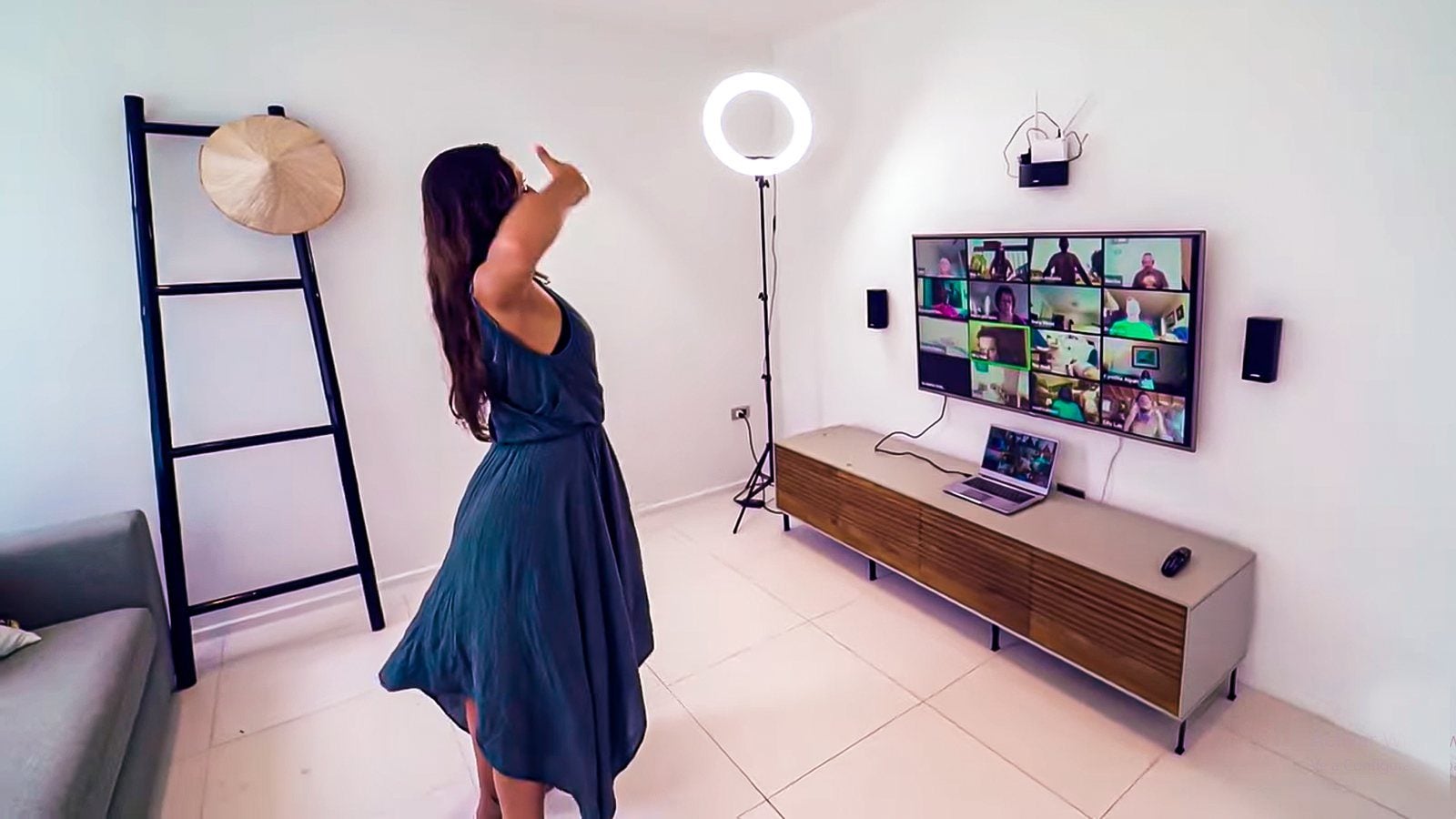
Live online classes. A facilitator on video, at a fixed time, with other people present. You can be seen, which matters more than it sounds. If you go pale or start to panic, somebody notices. Good ones cap numbers so the facilitator can watch faces.
On-demand guided sessions. Recorded audio or video, usually in an app, taken whenever you like. Nobody is watching, so the safety work has to be built into the recording: screening before you start, clear instructions, an easier variation, and permission to stop.
In-person classes. A studio, a hall, a beach at sunrise. Stronger group effect and a facilitator in the room with you. Also a commute, a fixed time, and whatever teachers live near you.
Courses. A structured sequence over weeks. A course teaches you to practise on your own. A class gets you through one experience. If you want a habit, you want a course.
Professional certification and teacher training. Training to guide other people. Different product, different buyer, bigger commitment. If you want to breathe on a Tuesday evening, you do not need it.
Why your search results keep showing teacher training
Type “online breathwork classes” into Google and the first page hands you four things at once: teacher training programmes, live sessions you could join tonight, free tasters in exchange for an email address, and explainers that never say where to actually practise.
Everyone selling breathwork uses these words loosely, ourselves included on a bad day. Three quick tests sort most of it out.
- If the page talks about clients, your practice, or building a business, it is facilitator training.
- If it lists modules, weeks or a curriculum, it is a course.
- If it gives you a date and a time zone, it is a live class.
Free sessions are worth taking, with one caution. A sample tends to be the gentlest version of a method. Judge the teaching and the screening, not the depth.
What about “breathwork classes near me”?
More people search for breathwork classes near them than for online ones, and an online class is not a local class.
An in-person class gives you things a screen cannot. A facilitator who can see your whole body. Live music. The steadying effect of thirty people breathing on the same beat. If you have a history of panic or dissociation, or you feel wary about intense fast breathing, in person with a trained facilitator is the better first choice.
Online gives you other things. You can practise at 6am on a Wednesday. You can stop without walking out of a room in front of anyone. You are not limited to whoever teaches within driving distance. Plenty of people run both: live sessions for depth, short home sessions for the consistency where most of the benefit accumulates. Breathwork at home covers the practicalities, and SOMA Breath runs in-person events and retreats for people who want the room.
The checklist that separates a good online class from a bad one
Nine checks. You can do most of them before paying anything.
1. Facilitator qualification. Who trained them, in what method, for how long. A named school with a published curriculum beats “certified breathwork practitioner” with no noun attached. Ask whether the training covered safety, not only technique.
2. Screening. A serious class asks health questions before you breathe. If nobody asks whether you are pregnant or live with a heart condition, it is not a safe class, however good the playlist is.
3. Contraindications stated in public. On the booking page, not buried in terms. Specific conditions named. A vague line about consulting your doctor is a legal shield rather than information.
4. Intensity options. Every instruction should have a gentler version: shorter holds, slower pace, nose only, eyes open. A facilitator with one setting for everybody has not thought about who is in the room.
5. Explicit stop instructions. You should be told out loud, early, that you can stop at any point, return to normal breathing, and that stopping is not failure. Nobody hands out medals in your bedroom.
6. Music and cue quality. This sounds cosmetic and is structural. If the music does not hold a steady tempo you end up counting, and counting drags you back into your head. Cues should be timed and specific: when to breathe, how deep, when to hold, when to release. Poetic narration over ambient pads is a pleasant way to lose half an hour.
7. Integration time. Several guided minutes of stillness at the end. Sessions that finish on the last breath hold and cut straight to an offer have cut the part that makes the rest worth doing.
8. Privacy. For live classes: can you keep your camera off, are sessions recorded, and who reads the health information you submit. For apps: what happens to your data.
9. Class size and support. Ask how many people attend and whether anyone besides the facilitator is watching. Then ask the question most people are too polite to ask.
What happens if someone becomes distressed during the session?
The answer you want is concrete. The facilitator notices, guides that person back to slow normal breathing, stays with them one to one while the group rests, checks in afterwards, and refers on to a qualified professional where appropriate. What you do not want is silence, or the suggestion that distress is always a breakthrough to push through. Strong emotion in a session is common and not a sign something has gone wrong. Being left alone with it is another matter.
What makes SOMA Breath different
SOMA Breath is a specific method rather than a general style. It was founded by Niraj Naik, a former pharmacist who came to breathing after a long illness of his own. Five features set it apart.
Fixed musical rhythm. Sessions are built on tracks at set tempos close to a resting heart rate, so the music carries the pace of the breath. You follow the beat instead of a count.
Breathe-in-beats guidance. The breathing pattern is encoded in the music, with audible cues marking inhale, exhale and hold. Niraj produced music before he taught breathing, and it shows.
Precise cues. Timed instruction rather than atmosphere. You are told the round length, the retention and the recovery, so you always know where you are.
Visualisation during retention. Attention becomes unusually receptive during and just after a breath hold. SOMA Breath uses that window for guided imagery: pick an intended state, build the scene, find where you feel it, then breathe into that spot.
Integration as part of the session. Guided and timed, not left to whatever is on your calendar next.
The retention approach draws on Dr. Prakash Malshe's 2011 paper describing nisshesha rechaka as a way to produce brief intermittent hypoxia. The paper proposed a mechanism. It did not test SOMA Breath or establish personal outcomes.
There are two doors in. Daily guided breathwork meditations run from 3 to 5 minutes up to longer journeys. The SOMA Breath app holds the full library and progressive programmes, including a 21 day sequence for people who want structure rather than a menu. If you would rather understand the mechanics first, breathwork techniques and how to practise works through them one at a time.
2 to 3 rounds most days does more for you than one dramatic 90 minute session a month.
Frequently asked questions
What are the best online breathwork classes?
Nobody can name one honestly, because it depends on what you want. For a daily habit, pick on-demand sessions in an app. For depth and a facilitator who can see you, pick live. To learn to practise alone, pick a course. Then apply the nine checks above.
Are online breathwork sessions as good as in-person ones?
For daily practice, yes. Often better, because you actually do them. For a first intense session, for strong emotional material, or for anyone with a panic or dissociation history, in person with a trained facilitator is safer.
What is the difference between an online breathwork course and online breathwork classes?
A class is one guided session. A course is a sequence of sessions with teaching attached, usually over several weeks, designed to leave you practising without guidance. Courses suit people who want a habit. Classes suit people who want an experience.
Do I need online breathwork certification to take a class?
No. Certification is professional training for people who want to guide others. You can attend classes for years without it.
Are there online breathwork classes in the UK?
Yes, and time zone is the only thing that really matters for live sessions. Check it before booking. On-demand sessions remove the problem entirely.
What does an online breathwork coach do?
Coaching is one to one rather than group, with a practice built around your situation and regular check-ins. It suits people who want accountability or have specific circumstances to work around. Verify the training the same way.
Can breathwork classes help with anxiety?
Many people report feeling calmer after a session, and slow breathing with a longer exhale is a reasonable thing to try. That is a state change rather than treatment. Breathwork is not a substitute for professional mental health care. If anxiety affects your daily life, start with a qualified clinician and keep breathing alongside it.
How do I find breathwork classes near me if there is nothing local?
Use live online classes for the group element, on-demand sessions for daily practice, and an in-person retreat once or twice a year for the full room experience. That combination beats waiting for a studio to open nearby.
Where to go next
Pick the smallest version and start this week rather than designing a perfect routine.
- Practise daily with guided breathwork meditations, from 3 to 5 minutes.
- Get the full library and progressive programmes in the SOMA Breath app.
- Set your home practice up properly with breathwork at home.
- Learn the methods in breathwork techniques and how to practise.
- Want the room and a facilitator in front of you? See upcoming events and retreats.
Important safety and medical information
This article is educational only. It is not medical advice. SOMA Breath is not intended to diagnose, treat, cure, or prevent any disease, and it is not a replacement for medication, therapy, or professional medical care. A certificate in a breathing method is not a clinical licence.
Slow, gentle breathing suits most people. Intense fast breathing and extended breath retention are different practices and carry real cautions. Speak with a qualified health professional before practising or facilitating these if you are pregnant, or live with epilepsy or a seizure disorder, cardiovascular disease, uncontrolled high or low blood pressure, an aneurysm, a retinal condition, severe asthma, a psychiatric condition, or a history of panic attacks or dissociation.
Never practise breath retention or fast breathing in or near water, including a bath, and never while driving or standing without support. Breath holding in water can cause loss of consciousness and drowning.
Stop if you feel chest pain, faintness, severe dizziness, numbness that does not pass, or distress that keeps building. Return to slow, normal breathing through the nose, lie down or sit supported, and let yourself settle before moving. If distress does not settle, or symptoms worry you, seek appropriate professional support.