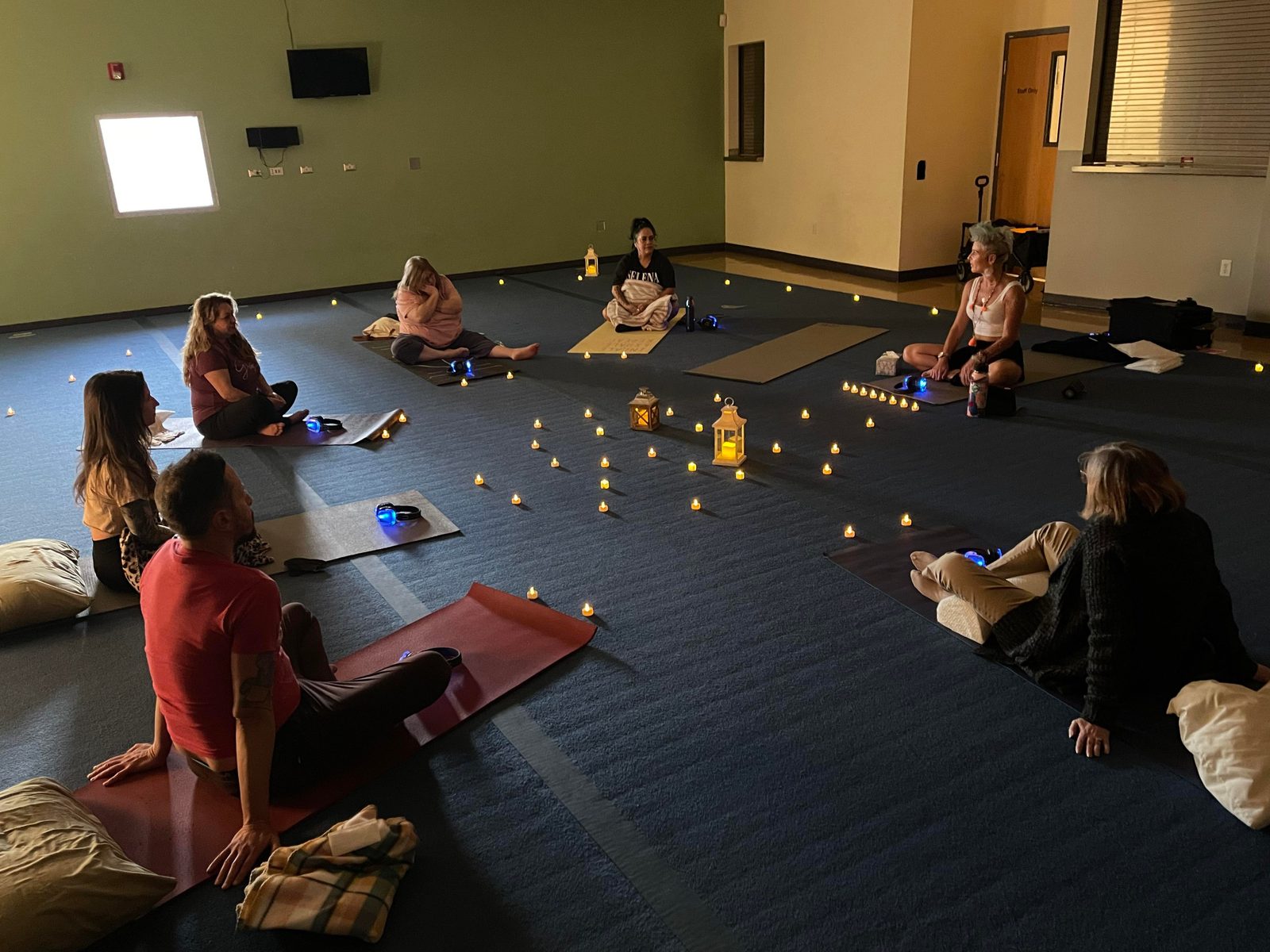
Somatic breathwork is breathwork that works through the body rather than the thinking mind. You use structured breathing to change your physical state first, then let the emotional and mental shift follow. The word somatic simply means “of the body.” In practice it means you stop trying to reason your way out of tension and instead give the nervous system a physical instruction it can actually follow.
That distinction matters more than it sounds.
Why talking about it is not always enough
Most of us have had this experience. You understand your problem perfectly. You can explain the pattern, name where it came from, describe exactly why it makes no sense. And you still feel it in your stomach at 3pm on a Tuesday.
Niraj Naik, who founded SOMA Breath after leaving pharmacy, puts the gap plainly: your mind knows, but your body has not received the memo.
This is the limitation somatic work is built to address. Approaches that operate purely through language and cognition treat the body as something the mind drives. Useful, up to a point. But if your nervous system is still physically configured for a threat response, insight alone is fighting uphill.
Somatic breathwork comes at it from the other direction. Breathing is the one part of your autonomic nervous system you can take manual control of at any moment. You cannot decide to lower your heart rate. You can change how you breathe, and your heart rate follows.
That makes the breath an unusually direct handle on your own physiology.
What actually happens in a somatic breathwork session
Sessions differ between schools, but most share a recognisable shape.
Arrival. A few minutes of slower breathing to settle. Nothing dramatic. This is where you notice what your baseline actually is, which is often busier than people expect.
Rhythmic phase. Structured breathing at a set pace, usually guided. This is the active portion and it is where the physical state begins to shift. You may feel tingling in the hands or face, temperature changes, or a heaviness in the limbs. All common.
Retention. A pause after the exhale, or sometimes after the inhale, held for a comfortable period. Brief and controlled, not a competition.
Integration. The part people skip and shouldn't. Breathing returns to normal and you rest. Whatever the session stirred up gets a chance to settle rather than being carried straight into your inbox.
Return. Slow re-entry, ideally without checking your phone within the first ninety seconds.
A full arc might run 20 to 40 minutes. Shorter practices of 10 minutes still do useful work, particularly for daily consistency.
What does somatic breathwork feel like?
Honest answer: variable.
Common reports include tingling, warmth, emotional release that arrives without an obvious trigger, involuntary shaking or trembling, a sense of pressure lifting from the chest, and occasionally tears with no accompanying sad thought. That last one surprises people. It is generally the body discharging held tension rather than a sign anything has gone wrong.
Some sessions feel profound. Some feel like lying on a mat wondering whether you left the oven on. Both are normal. The cumulative effect matters more than any single session.
How SOMA Breath approaches it
SOMA Breath is one method within the broader somatic breathwork category. It combines three elements.
Structured pranayama with brief breath retention. Niraj developed this side of the method with Dr. Prakash Malshe, a medical doctor who has published on the physiology of yogic breathing. The counterintuitive finding at the centre of it: pranayama appears to work not by increasing oxygen but by briefly reducing it. Research suggests short periods of controlled low oxygen prompt cellular adaptation. That research is genuinely promising and still developing, and it is covered separately in the scientific explanation of SOMA Breath and in more depth on intermittent hypoxia.
Music as the delivery mechanism. Niraj spent years as a music producer before this, and it shows in the design. Tracks are built at tempos around 60 and 120 beats per minute, close to a healthy resting heart rate, so the rhythm carries the breathing pattern. The practical benefit is that you are not counting. Counting is what makes breathwork feel like homework, and homework is what people quietly abandon by Thursday.
NeuroSomatic Programming. During and just after breath retention, attention tends to become unusually receptive. SOMA Breath uses that window for guided visualisation: choose an intended state, build a vivid mental scene, locate where you physically feel it, notice what colour arises, then breathe that colour into the sensation and let it expand.
The colour step sounds mystical and has a reasonably grounded explanation. Your brain is a pattern-compression machine. Handed a flood of new bodily signals, it summarises them into a simple sensory symbol. The colour is a snapshot of your nervous system at that moment, not a diagnosis. And notably, a colour that arises from within tends to land harder than one handed to you, because your brain treats self-generated data as more relevant than external instruction.
Is somatic breathwork the same as somatic therapy?
No, and conflating them causes real problems.
Somatic therapy is a clinical modality delivered by licensed practitioners with training in trauma and mental health. Somatic breathwork is a wellness and educational practice. There is genuine overlap in what they pay attention to, and they are not interchangeable.
A breathwork facilitator can hold a supportive space, teach a technique, and notice when someone needs to slow down. A facilitator cannot diagnose, treat, or manage a psychiatric condition, and a certificate in a breathing method does not confer a clinical licence. Anyone suggesting otherwise should be treated with suspicion.
If you are working with significant trauma, the sensible sequence is a qualified therapist first, with breathwork alongside if your clinician agrees it is appropriate.
How to start without overcomplicating it
You do not need a workshop to begin.
Week one. Five minutes daily of slower breathing with a longer exhale than inhale. Try four counts in, six or eight out, through the nose. The extended exhale is what signals your system it can stand down.
Week two. Add attention to sensation. As you breathe, notice where in your body you feel tension. Do not analyse it. Just locate it. This is the somatic skill and it takes practice, because most of us have spent years learning to ignore exactly this signal.
Week three. Try a guided session with music. This is where structure helps, particularly for retention phases where having a voice and a rhythm removes the guesswork. Guided journeys sit in the SOMA Breath app, and there is a free guided session if you want to feel the method before committing to anything.
Ongoing. Consistency beats intensity by a wide margin. Ten minutes daily outperforms a ninety-minute session every third Sunday.
One useful marker: notice how quickly you settle at the start of each practice. That interval shortening over weeks is a more meaningful signal than anything dramatic happening mid-session.
Frequently asked questions
What is somatic breathwork in simple terms?
Breathing practices used deliberately to change your physical state, so that emotional and mental change follows. It works bottom-up, through the body, instead of top-down through analysis.
What is somatic release?
The point in a session where held physical tension discharges. It can show up as shaking, trembling, warmth, tears, or a sudden sense of lightness. It is usually brief. Integration time afterwards is what lets it settle properly.
Is somatic breathing the same as deep breathing?
Not quite. Deep breathing is one technique. Somatic breathing is the broader approach of using breath while tracking bodily sensation, which may include slow breathing, rhythmic breathing, retention, toning, or movement.
Do I need training to practise it?
Not for gentle slow breathing on your own. Intense fast breathing and longer retentions are better learned with guidance, and facilitating for other people requires proper training in both technique and safety. If you are considering that path, the facilitator and teacher training explains what is involved.
How long before I notice anything?
Many people feel calmer within a single session, which is a state change rather than a lasting one. Shifts in your baseline generally take weeks of regular practice. Three weeks of daily short sessions is a reasonable window for judging whether it suits you.
Can I do it every day?
Gentle slow breathing, yes. Intense sessions with extended retention are usually better two or three times a week with lighter practice in between, in the same way you would not sprint every day.
Where to go next
Pick the smallest version and start this week rather than planning a perfect routine.
- Try a free guided SOMA Breath session to feel the method rather than read about it.
- Practise regularly with the SOMA Breath app.
- For the physiology, read the scientific explanation of SOMA Breath.
- Curious about the research on breath holds? Start with intermittent hypoxia.
- Thinking about facilitating for others? See the facilitator and teacher training.
Important safety and medical information
This article is educational only. It is not medical advice. SOMA Breath is not intended to diagnose, treat, cure, or prevent any disease, and it does not replace medication, therapy, or professional medical care. Certification in a breathwork method is not a clinical licence.
Slow, gentle breathing suits most people. Intense fast breathing and extended breath retention are different practices and carry real cautions. Speak with a qualified health professional before practising or facilitating these if you are pregnant, or live with epilepsy or a seizure disorder, cardiovascular disease, uncontrolled high or low blood pressure, an aneurysm, a retinal condition, severe asthma, a psychiatric condition, or a history of panic attacks or dissociation.
Never practise breath retention or fast breathing in or near water, in a bath, while driving, or while standing without support. Breath holding in water can cause loss of consciousness and drowning.
If a practice brings up distress that does not settle, stop, breathe normally, and seek appropriate support. Strong emotional responses are not automatically a problem, and they do deserve proper care rather than being pushed through.