
You can practise breathwork at home in 10 minutes, with no equipment, no class, and no experience. Sit down, put on a track with a steady rhythm, breathe in time with it, and allow a gentle pause after each exhale. That is the starting point. Everything below is how to do it properly, and how to keep doing it once the novelty wears off.
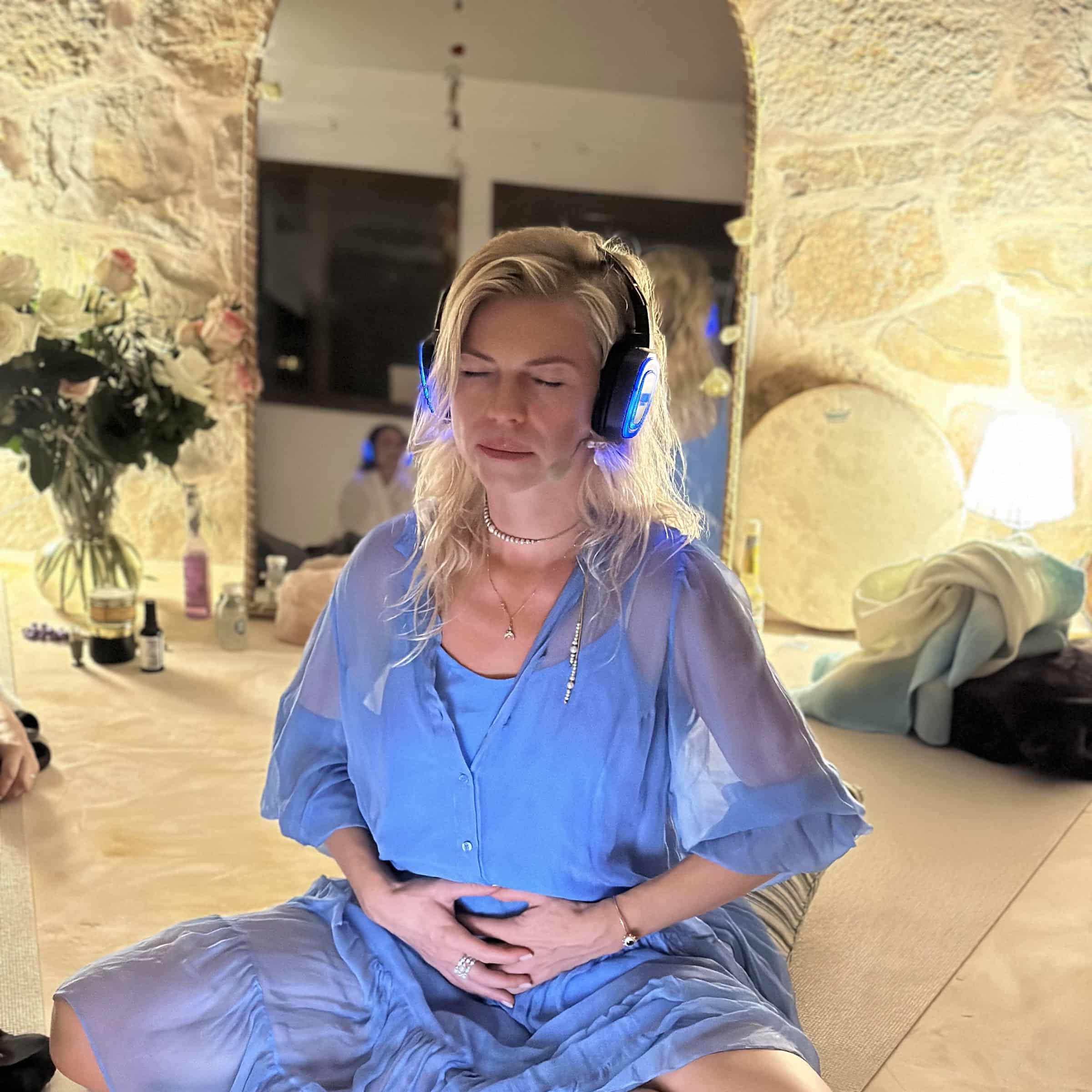
Why home practice usually falls apart
Most people do not stop because breathwork failed them. They stop because they turned it into another job.
You know the pattern. You read something good, you decide you will do twenty minutes every morning, you manage four days, you miss a Tuesday, and by the following week the whole thing is gone. Nothing went wrong physically. The plan was just built for a version of you who has spare willpower at 6am.
Here is the more useful way to think about it. Most people do not need another routine to stick to. They need a practice that sticks to them.
That distinction is the whole reason SOMA Breath is built around music. When you breathe along to a rhythm, the track carries the timing for you. You are not managing a technique in your head while also trying to relax. You press play and follow. It becomes something you look forward to rather than something you owe yourself.
There is a second reason home practice stalls, and it is worth naming. People start with the hardest version they have seen online, find it unpleasant or frightening on their own, and conclude breathwork is not for them. What they actually discovered is that the advanced version is a poor place to begin. The gentle version is not a watered-down substitute. It is the foundation the intense work is built on.
What you actually need to start
Very little.
- A place to sit or lie down where you will not be interrupted for 10 minutes.
- Headphones, if you are using music.
- Your nose. Most of this is nasal breathing.
- 10 minutes. 5 is enough on a bad day.
You do not need a mat, a candle, a retreat, or a teacher standing over you. Niraj Naik has always been blunt about this part. The equipment is not the barrier. The barrier is starting.
One rule before anything else. Always practise seated or lying down, somewhere safe. Never in or near water, never in a bath, never while driving, and never standing up unsupported. This matters more than any technique on this page.
Find your baseline first
Before you change anything, it helps to know where you are starting from.
The simplest home measure is your morning breath hold time. It comes from the work of Dr Konstantin Buteyko, the Russian physician who spent his career studying breathing efficiency, and it takes about a minute.
Do it first thing, before you get out of bed:
- Sit up comfortably.
- Take a normal, relaxed breath in through your nose. Not a big one.
- Exhale fully through your nose.
- Pinch your nose and start a timer.
- Hold until you feel the first clear urge to breathe. A twitch, a slight discomfort. This is not a willpower contest.
- Stop the timer and breathe in calmly through your nose.
Write the number down.
Most people who have never trained their breathing land somewhere in the 20s. 40 seconds and above tends to show up in people whose everyday breathing is already slow and efficient. Lower numbers tend to go with faster, shallower, more upper-chest breathing.
Be clear about what this number is and is not. It is a personal tracker, useful only against your own previous scores. It is not a medical test, it does not diagnose anything, and a low score is not a verdict on your health. Anyone telling you otherwise is overselling a stopwatch.
It is also not a competition with yourself. Holding until you are desperate does not give you a better number, it gives you a number measuring your stubbornness. The first definite urge to breathe is the marker.
Retest once a week, same time, same conditions. Watching it move is genuinely motivating, which is the real point of measuring it at all.
The 10 minute home practice
This is the version to start with. Two parts, both gentle.
Part one: breathe with the rhythm, 5 minutes
Put on a track with a steady, slow beat. Breathe in for a set number of beats, breathe out for the same, and stay with it. Nose in, nose out, belly moving rather than shoulders.
If you want a target to work toward, slow breathing sits at fewer than 10 breaths per minute, with the exhale roughly twice as long as the inhale. A 1:2 ratio. Do not force that on day one. Let the rhythm pull you down toward it over a few weeks.
Breathing through the nose is not a stylistic preference. Nasal breathing filters, warms and humidifies the air, and it produces nitric oxide, which helps oxygen actually get delivered into tissue. Mouth breathing skips all of that. If you can only manage nasal breathing for the first 2 minutes, do 2 minutes.
The reason to use music rather than a timer is simple. A timer makes you monitor yourself. A rhythm gives you something to follow. 10 minutes of following feels shorter than 3 minutes of counting, and you are far more likely to come back tomorrow.
Part two: the pause after the exhale, 5 minutes
This one is called bahya kumbhaka, and it is the gentlest entry point into breath training there is.
- Sit comfortably and close your eyes.
- Breathe naturally through your nose. Do not control it.
- Notice the moment your exhale ends.
- Let a small pause happen there. Do not rush to breathe in.
- Inhale when your body genuinely wants to.
- Repeat for 5 minutes.
That is it. No effort, no strain, no holding on grimly. You are simply not rushing the next breath.
What this trains is carbon dioxide tolerance. Most people breathe slightly too much, too fast, and their system becomes twitchy about CO2 rising even a little. This matters more than it sounds, because CO2 is not just waste gas. It is what allows haemoglobin to release oxygen into your tissue in the first place. Breathe too hard and you can end up with plenty of oxygen in your blood and less of it reaching where it is needed.
Allowing that natural pause teaches the reflex to settle. As it settles, your resting breathing slows down on its own, and your morning breath hold time climbs.
Start at 5 minutes daily, morning or before bed. Build to 10 or 15 minutes when it feels easy.
How often, and for how long
Daily beats heroic.
The research on this is consistent. Regular, moderate, predictable practice outperforms occasional intense sessions. 10 minutes every day will do more for you than 90 minutes once a fortnight, by a wide margin. This is the same principle behind any kind of physical conditioning, and breathing is no different. The system adapts to what it meets regularly, not to what impresses it occasionally.
If you want a structure with a defined endpoint, the SOMA Breath 21 day approach builds gradually across 3 weeks: a short, gentle session in week 1, longer in week 2, longer again in week 3. The progression matters. Starting at week 3 because you feel keen is the single most common beginner mistake.
Here is what a realistic first few months looks like:
- Weeks 1 to 2: You mostly notice how shallow and fast your normal breathing has been. Sessions feel pleasant, sometimes a bit boring. This is fine.
- Weeks 3 to 4: Your breathing rate starts dropping. Nasal breathing begins replacing mouth breathing without you thinking about it.
- Months 2 to 3: The breath gets smoother. Many people notice sleep and general steadiness improve before they notice anything else.
- Months 4 to 6: Breathing becomes quieter and more subtle. Your breath hold time reflects the change.
That timeline is a rough map, not a promise. Some people move faster, some slower, and how you sleep and how much stress you are under will move it either way.
Nobody is handing out medals in your bedroom. Consistency is the only variable that reliably matters.
What if you miss a day?
You start again the next day. That is the entire protocol for a missed day.
The reason this needs saying is that missing days is what kills most home practices, and it is almost never the missed day that does the damage. It is deciding that the streak is broken so the whole thing is ruined. Two sessions a week, sustained for a year, beats a perfect fortnight followed by nothing.
What about the intense sessions?
You will have seen the other kind of breathwork online. Fast, hard breathing, big emotional releases, people on the floor.
That style has its place, and SOMA Breath includes structured intense work at the right stage. But it is not where you start alone at home, and it deserves respect rather than enthusiasm.
Rapid, forceful breathing changes your blood chemistry quickly. It can bring on dizziness, tingling, cramping in the hands, and for some people strong emotional material with nobody there to support them. If you are currently very stressed, running on empty, or carrying something heavy, an intense solo session is the wrong tool. Go slower, go gentler, and get support.
Long, calm breath holds are a different matter and are a normal part of trained practice. The caution here is specifically about fast, forceful breathing done alone before you have any foundation.
Safety, plainly
This article is educational only and is not medical advice. Breathwork does not diagnose, treat, cure, or prevent any condition, and it does not replace medication, therapy, or care from a qualified professional. If you are under treatment for anything, talk to your doctor before starting.
Do not practise breath retention or fast breathing, and speak to a doctor first, if any of these apply:
- pregnancy
- epilepsy or any seizure condition
- cardiovascular disease, or a history of stroke or aneurysm
- uncontrolled high blood pressure
- retinal conditions or glaucoma
- severe or brittle asthma
- a psychiatric diagnosis, or a history of panic attacks, dissociation, or psychosis
And again, because it is the one that actually hurts people: never practise breath holds in or near water, never while driving, never standing unsupported.
If you feel dizzy, stop and breathe normally. Nothing here is worth pushing through.
Common questions about breathwork at home
Can you really do breathwork at home on your own?
Yes, for the foundational work. Slow rhythmic breathing, nasal breathing, and the pause after the exhale are all safe to learn by yourself, and they deliver most of the everyday benefit. Guided sessions and ceremonies with a facilitator become worthwhile when you want the deeper, more intense practices.
How long should a beginner practise for?
10 minutes a day. 5 on a difficult day. Longer sessions are not better until the short ones have become automatic.
Is a beginner online breathwork course worth it, or can I just follow free sessions?
Free guided sessions are a perfectly good way to find out whether you like this. A structured beginner course earns its place when you want a sequence that progresses properly rather than a shuffle of unrelated sessions, and when you want the intense techniques introduced in a sensible order.
What time of day is best?
Morning suits most people, because it sets your state before the day gets hold of you. Before bed works well for the slow, gentle version. Avoid intense practices late at night.
Do I need music, or can I practise in silence?
Silence works. Plenty of traditions have used nothing else for centuries. Music is in SOMA Breath because it solves a specific practical problem: it holds the timing so you do not have to, which makes a session easier to stay with and easier to return to. If silence keeps you coming back, use silence.
What if I feel dizzy or my hands tingle?
Stop and breathe normally through your nose until it passes. Tingling and light-headedness usually mean you are breathing harder or faster than you need to. It is a signal to ease off, not a sign of progress.
How do I know it is working?
Three signals. Your morning breath hold time rises. You catch yourself breathing through your nose without deciding to. And the gap between something annoying happening and you reacting to it gets slightly wider. That last one is the one that changes your life, and it is the one nobody measures.
Where to go next
If you want to understand the individual methods first, read the guide to breathwork techniques, try the morning breathing exercises, or explore somatic breathwork.
Home practice usually falls apart for boring reasons. You lose the count. You sit down unsure which session fits how you feel. You cannot tell if anything is changing.
That is the gap the SOMA Breath® app closes. Open the Vibe Selector and choose where you want the session to take you: calm down, clear your head, get energy or sleep. The app picks the session. Breathe In Beats music guides your breathing, so you do not need to count. In the Breathe Room, you can choose Sleep, Relax, Calm Down or Daily Dose, then adjust the cycles, pacer and sound.
The MBHT Tracker logs your score, health zone and estimated breathing rate. Daily Dose and the IHT Tracker take you through graded breath-hold levels from beginner to advanced. HRV Readiness helps you match the practice to the moment, with optional pulse oximeter support. Streaks, badges and insights show when you practise and how your monthly MBHT trend is moving.
The Daily Practice Builder can assemble your morning, daytime and evening practice, from 15 minutes to a full hour. The library holds more than 500 hours of sessions, with new tracks every two weeks. It also includes the Breath Pharmacy protocols and the full 21-Day Awakening Protocol.
Practising at home does not mean practising alone. The Global Coherence Room connects people breathing live across more than 50 countries. You can also use the app to find certified instructors, nearby classes, live events, Breath Raves and replays.
Get the SOMA Breath® app at 50% off
The offer includes a 30-day money-back guarantee. Start tomorrow morning. Pick how you want to feel, press play and let the music guide your breath.
The practice only works if it is easy enough that you actually do it.