
Breathwork is the deliberate use of breathing patterns to change how your body and mind are working right now. You alter the pace, depth, rhythm, or pauses of your breath on purpose, and your nervous system responds. Some styles calm you down in three minutes. Others are intense enough to produce altered states of awareness. All of them share the same lever.
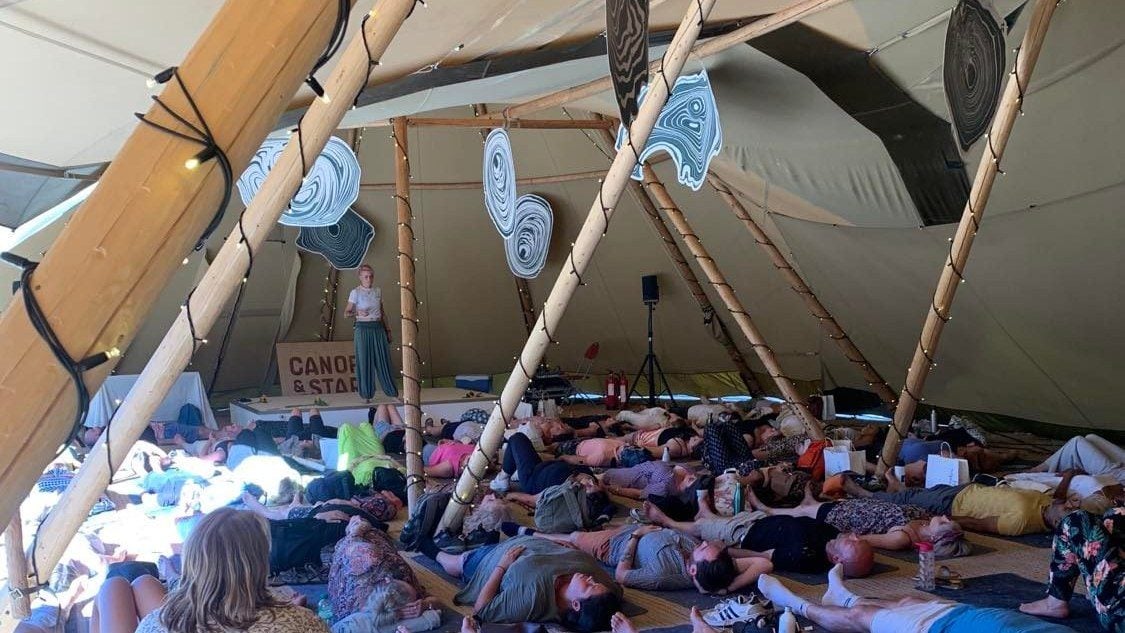
That lever is unusually direct, and there is a reason for it.
Why the breath specifically, and not something else
You breathe roughly 20,000 times a day without deciding to. It is the one major autonomic function you can also take manual control of whenever you want. You cannot choose to lower your blood pressure. You cannot instruct your gut to relax. You can change how you breathe in the next second, and a lot of downstream physiology follows.
Niraj Naik, a pharmacist who left the profession after a serious autoimmune illness and went on to found SOMA Breath, puts the priority in blunt terms. You can survive weeks without food and days without water. Minutes without breath. Yet most people obsess over what they eat and never once examine the thing they do 20,000 times a day.
The clinical trail here is older than the wellness industry. In the 1950s a Russian doctor, Konstantin Buteyko, was trying to work out why some patients were permanently unwell with fatigue and endless colds while others seemed resistant to all of it. He wired people up and monitored breathing rate, carbon dioxide tolerance, heart rate, and stress markers.
The people who rarely got sick shared one habit. They breathed differently. Not deeper or harder. Slightly slower, and through the nose.
Buteyko's conclusion was that habitual over-breathing keeps the body in a low-grade defensive state it can never resolve. Change the breath and everything else gets easier. That claim is now the working assumption behind most modern breathwork, whether the teacher has heard of Buteyko or not.
What actually changes in the body
Three mechanisms do most of the work. Understanding them is the difference between breathwork sounding mystical and breathwork sounding like physiology.
Your heart rhythm follows your breath rhythm. Your heart does not beat like a metronome. The gap between beats constantly adjusts, and that variation is called heart rate variability, or HRV. Higher variability generally indicates a system that can adapt. Inhaling nudges the sympathetic branch of your nervous system and speeds the heart slightly. Exhaling engages the parasympathetic branch and slows it. Breathe rhythmically and those two swings line up into a smooth, repeating pattern, which is what people mean by cardiac coherence. Dr Alan Watkins, a physician and neuroscientist whose work Niraj draws on, points to a research literature of more than 19,000 published papers examining HRV as a marker of health and resilience.
Dr B.M. Hegde, a former Vice Chancellor of Manipal University and one of India's more outspoken medical academics, takes it further. His position is that every biorhythm in the body sits downstream of the rhythm of the breath. Heartbeat, hormone cycles, sleep architecture, cellular metabolism. Breathe rhythmically for a few minutes and you are adjusting the master tempo rather than one instrument.
Carbon dioxide governs oxygen delivery. This is the part that reliably surprises people. Breathing faster does not oxygenate you better. Blowing off too much carbon dioxide makes it harder for haemoglobin to release the oxygen it is already carrying. Building tolerance to slightly higher carbon dioxide is a large part of why slow breathing and gentle pauses work at all.
Brief low oxygen triggers adaptation. Dr Prakash Malshe, a medical doctor who wrote A Medical Understanding of Yoga, argued that classical pranayama works not by increasing oxygen but by briefly reducing it. Short, controlled dips prompt cellular adaptation responses. This is the mechanism behind intermittent hypoxic training, and it is genuinely promising rather than settled. The research and its limits are covered separately in the scientific explanation of SOMA Breath and in more detail on intermittent hypoxia.
What are the main types of breathwork?
The word covers a wide range of practices with very different intensities and origins. Lumping them together is how people end up in a session far stronger than they wanted.
Slow and functional breathing. Coherence breathing, extended exhales, nasal breathing retraining, Buteyko-style work. Around five to six breaths a minute is the usual coherence target. A four count in and eight count out is the standard pattern for settling the system. Low risk and undramatic, and the version most people should start with.
Pranayama. The classical yogic family, thousands of years old, including alternate nostril breathing, ratio breathing, and controlled retention known as kumbhaka. Ranges from very gentle to very advanced depending on the technique.
Fast, connected, cathartic styles. Stanislav Grof, a Czech psychiatrist, developed Holotropic Breathwork after his psychedelic research, using sustained connected breathing over long sessions to surface deep emotional material. Leonard Orr, working independently in the same era, developed Rebirthing Breathwork using gentle continuous breathing, often in warm water. These are the most intense end of the category and the reason facilitator training exists. The differences are set out in holotropic breathwork versus SOMA Breath.
Heat and cold styles. Tummo, the Tibetan inner fire practice, and the Wim Hof Method that adapted parts of it. Both combine strong breathing with cold exposure. Wim Hof has said he learned a great deal from Tibetan tantric yogis, and his son named the company Inner Fire, which is the literal translation of Tummo.
Somatic breathwork. Breathwork paired with tracking bodily sensation rather than analysing thoughts. Covered properly in what somatic breathwork is.
Rhythmic, music-led breathwork. Structured breathing guided by a musical tempo instead of counting. This is where SOMA Breath sits, and the music is doing real work rather than sitting in the background.
Does breathwork actually work, or is it wellness marketing?
Both, depending on who is selling it.
The honest position is that the evidence base is uneven. Slow breathing for short-term calming is well supported and unsurprising, because you are directly manipulating autonomic input. The bigger claims about lasting change are earlier-stage research with smaller samples.
One study is worth knowing about. In 2021 Dr Evan Lewis-Healy and Dr Tristan Beckinstein of the Consciousness and Cognition Lab in Cambridge's Department of Psychology approached Niraj to study the SOMA Breath protocol. They chose it for a specific and slightly unromantic reason: because participants breathe in time to a fixed musical tempo, every person in the study receives the same intervention. Same rhythm, same retention timings, same dose. That makes results measurable and reproducible in a way that self-paced breathwork does not.
Their findings included increased complexity in brain signals during sessions, and participant reports of markedly altered states during the retention phases. The researchers discussed breathwork as a possible non-drug route to some of those states, and further clinical trial work has been proposed.
Read that carefully, because this is where breathwork marketing usually overreaches. A university studying a method is not a university endorsing a company. Increased neural complexity is a measurement, not a health outcome. And nothing in that work makes breathwork a substitute for psychiatric care or medication. Anyone telling you otherwise is selling something.
What breathwork is well suited to: daily state regulation, sleep onset, stress recovery, and building a practice you will actually keep. If you want the sleep angle specifically, see SOMA Breath for sleep.
What happens in a session
Most guided sessions follow a recognisable arc.
Arrival. A few minutes of slower breathing. Unglamorous, and the point where you notice your actual baseline, which is usually busier than expected.
Rhythmic phase. Structured breathing at a set pace. Tingling in the hands or face, temperature changes, and heaviness in the limbs are all common and not alarming.
Retention. A pause after the exhale, held for a comfortable period. Brief and controlled. Nobody is handing out medals in your bedroom.
Integration. Breathing returns to normal and you rest. This is the part people skip and the part that matters, because it lets whatever the session stirred up settle rather than being carried into your inbox.
A full arc runs 20 to 40 minutes. Ten minutes still does useful work, and consistency beats duration by a wide margin.
Some sessions are profound. Some feel like lying on a mat wondering whether you left the oven on. Both are normal.
How SOMA Breath approaches it
SOMA Breath combines three components, which is the clearest way to explain what it is and what it is not.
Structured pranayama with brief retention. Rhythmic breathing with controlled pauses, giving a small daily dose of intermittent hypoxic training. Built with reference to Dr Malshe's work on the physiology of yogic breathing.
Music as the delivery system. Niraj spent years as a DJ and producer before any of this, and it shows. Tracks are built around 60 and 120 beats per minute, close to a healthy resting heart rate, so the rhythm carries the breathing pattern. The practical effect is that you stop counting. Counting is what makes breathwork feel like homework, and homework is what people abandon by Thursday.
NeuroSomatic Programming. During and just after retention, attention tends to become unusually receptive. That window is used for guided visualisation: choose an intended state, build a vivid mental scene, find where you physically feel it, notice what colour arises, then breathe that colour into the sensation.
The colour step sounds mystical and has a fairly grounded explanation. Your brain compresses a flood of new bodily signals into a simple sensory symbol. The colour is a snapshot of your nervous system in that moment, not a diagnosis. A colour that arises from inside you tends to land harder than one handed to you, because the brain gives more weight to self-generated data than to external instruction. The NHS uses a simplified version of colour breathing with prescribed calming colours in some settings, which is a useful precedent for the general idea and not an endorsement of this method.
How to start this week
Skip the equipment. Start with a measurement.
Find your baseline. The Morning Breath Hold Time test comes from Buteyko's work. First thing in the morning, before getting out of bed, sit up. Normal breath in through the nose, full exhale through the nose, pinch your nose, start a timer. Hold until the first definite urge to breathe, which is a twitch or slight discomfort rather than a test of willpower. Stop the timer.
As a rough guide from that tradition: 10 seconds or less is a red flag, 20 to 30 is average, 30 to 40 is a healthy range, and 40 or more is considered strong. Treat this as a self-tracking number, not a medical test. It diagnoses nothing. Its value is watching your own figure move over 21 days.
Week one. Five minutes daily of slow nasal breathing with a longer exhale than inhale. Four counts in, eight out. The extended exhale is the signal your system can stand down.
Week two. Same practice, plus attention to where you feel tension. Do not analyse it. Just locate it.
Week three. Try a guided session with music, where the rhythm handles the timing for you. There is a free guided SOMA Breath session if you want to feel it rather than read about it, and the SOMA Breath app for regular practice.
If you want the specific patterns written out, they are in breathwork techniques and how to practise them.
Expect the following, based on the progression Niraj describes. Weeks one and two, you mostly become aware of how shallow your normal breathing is. Weeks three and four, resting breath rate drops and nasal breathing starts replacing mouth breathing. Months two and three, the breath becomes smoother and sleep tends to improve. The destination the yogic tradition points at is a breath so quiet you barely notice it, nasal, steady in tempo, driven by the diaphragm rather than the upper chest, with a natural pause after the exhale.
Frequently asked questions
What is breathwork in simple terms?
Using deliberate breathing patterns to change your physical and mental state on purpose. Slower breathing to calm down, stronger breathing to energise or to surface emotional material, and structured pauses to build carbon dioxide tolerance.
Is breathwork the same as meditation?
No, though they overlap. Meditation is primarily a practice of attention. Breathwork actively manipulates your physiology to shift state, which is why people often find it easier to get somewhere with breathwork when their mind is too busy to sit still. Many people use breathwork first, then meditate from the calmer state it produces.
What are the main breathwork techniques?
Slow coherence breathing at five to six breaths a minute, extended exhale patterns such as four in and eight out, nasal breathing retraining, classical pranayama including alternate nostril breathing and retention, fast connected styles such as Holotropic and Rebirthing, cold-paired methods such as Tummo and the Wim Hof Method, and rhythmic music-led breathing.
Can you do breathwork at home?
Yes, for gentle slow breathing. Learn intense fast breathing and longer retentions with guidance first, and never practise them in or near water.
What is somatic breathwork?
Breathwork done while tracking physical sensation rather than reasoning about the problem. It works from the body upward instead of the mind downward.
What is holotropic breathwork?
A sustained connected breathing method developed by the psychiatrist Stanislav Grof, usually run in long facilitated sessions and aimed at surfacing deep emotional material. It sits at the intense end of the category and is not a starting point.
Is DMT breathwork a real thing?
The nickname comes from how intense some retention experiences feel, not from a measured molecule. There is no solid human evidence that breathwork floods the body with DMT. The Cambridge work measured brain signal complexity and participant reports, not endogenous chemistry. The experiences are real. The proposed explanation is unproven, and anyone stating it as fact is going beyond the evidence.
Do you need a certification to teach breathwork?
The field is largely unregulated, which is precisely why training matters. Teaching intense techniques to other people involves screening for contraindications and managing strong emotional responses, and neither is intuitive. If you are considering that path, the facilitator and teacher training sets out what is involved. A breathwork certificate is not a clinical licence and never has been.
Should I look for a breathwork class near me or practise online?
Online guided practice is better for daily consistency and costs less. In-person is better for your first intense session, because having an experienced facilitator in the room matters when something unexpected comes up. Most people do best with both.
How long before I notice anything?
Many people feel calmer inside one session, which is a state change rather than a lasting one. Baseline shifts usually take weeks. Three weeks of short daily practice is a fair window for deciding whether it suits you.
Where to go next
Pick the smallest version and start this week rather than designing a perfect routine.
- Try a free guided SOMA Breath session to feel the method.
- Practise daily with the SOMA Breath app.
- Learn the specific patterns in breathwork techniques and how to practise.
- For the physiology, read the scientific explanation of SOMA Breath.
- For the research on breath holds, start with breathwork and stem cells.
- Thinking of teaching it? See the facilitator and teacher training.
Important safety and medical information
This article is educational only. It is not medical advice. SOMA Breath is not intended to diagnose, treat, cure, or prevent any disease, and it does not replace medication, therapy, or professional medical care. A certification in a breathwork method is not a clinical licence. The Morning Breath Hold Time test is a self-tracking tool, not a diagnostic test, and a low score does not identify any medical condition.
Slow nasal breathing suits most people. Intense fast breathing, extended breath retention, and cold exposure are different practices and carry real cautions. Speak with a qualified health professional before practising or facilitating these if you are pregnant, or live with epilepsy or a seizure disorder, cardiovascular disease, uncontrolled high or low blood pressure, an aneurysm, a retinal condition, severe asthma, a psychiatric condition, or a history of panic attacks or dissociation.
Never practise breath retention or fast breathing in or near water, in a bath, while driving, or while standing without support. Breath holding in water can cause loss of consciousness and drowning. Build intensity gradually rather than pushing for a number.
If a practice brings up distress that does not settle, stop, breathe normally, and seek appropriate support. Strong emotional responses are not automatically a problem, and they do deserve proper care rather than being pushed through.